Showing posts sorted by date for query Enduimet. Sort by relevance Show all posts

Friday, January 13, 2012

Tanzania Wildlife Management Area program


This video describes the Wildlife Management Area concept in Tanzania that I was involved with in 2010. Much of it was filmed in the Enduimet WMA where I taught the village game scouts how to contuct resource monitoring. The video is quite well done and describes the challenges the WMA's are facing and includes a number of people I worked directly with at Enduimet or at USAID.
It was wonderful and very rewarding work, but I feel that we had just begun to get our training to the point where it would be effective and then we left with no follow up. It's not just that I didn't get to go back to Tanzania either- I really felt that we were making a difference and really just getting started. The people that I worked with were very appreciative of us being there and I don't like the feeling that I have not been able to follow up and help out more.


Sunday, January 30, 2011

Return to Tanzania


Since it looks like we broke the record for the most snow for the season last night (still snowing now) and the temperature is heading well below the zero mark for the next few days, I think that it is about time to return to Tanzania. But it looks the only way I am going to be able to do that is post about it here.


To recap, I was in Tanzania to train Village Game Scouts (VGS) how to conduct more rigorous natural resource monitoring as part of their regular duties conducting anti-poaching patrols at the Enduimet Wildlife Management Area (WMA).


Enduimet WMA is located west of Mount Kilimanjaro along the border with Kenya.


I was part of a team working for the Department of Interior's Technical Assistance Program. There were ten of us on the team, divided into five teams of two, each team assisting with a different WMA. My partner at Enduimet was Janet, a botanist from the US Fish and Wildlife Service in Alaska.


This is Eric, our driver.


We worked very closely with the Longido District Game Officer (DGO) Stephen (on the right), his local commander Charles (on the left), and Julius (middle), a representative for the African Wildlife Foundation, a non-governmental agency partner in the management of the WMA.


When we arrived at Enduimet, we toured the VGS outposts in the WMA. These guys are amazing. They accomplish a lot with little resources. The shed in the back is where they cook and store their equipment. They sleep in small individual tents scattered around the outpost. The conduct anti-poaching patrols on foot from their outposts and spend four weeks at a stretch on duty.


Our training was conducted at the WMA headquarters in the village of Ol Malog. Each morning the scouts would go through their drills prior to the training.


We spent most of our time outside doing more practical instruction. Here Janet is teaching the scouts how to set up and run a habitat transect to measure vegetation.


We did spend some time inside the WMA headquartes in the village of Ol Malog. Here the scouts are going through the field guides we provided them, The Birds of East Africa and the Kingdon Pocket Guide to African Mammals. I would recommend both guides for any trip to East Africa.


We also taught the scouts how to measure grass biomass using the pasture disk method.


Since there wasn't much wildlife near the village, we improvised and used the numerous cattle, sheep or goats as surrogates when we taught the scouts how to conduct wildlife transect surveys.


At the end of the training we had the scouts run their own transect as a practical test. The transect was run from one of the outposts and this time we had real African wildlife to use on the transect.


At the end of our training we had a ceremony with a number of dignitaries where the scouts received their certificates of completion. Here Obedi is reciting a speech where he expressed the scouts appreciation for being selected to receive the training as well as appreciation for the content of the training.


The primary management challenge at Enduimet is the heart of this type of conservation effort - how to integrate local people and villages into conservation efforts so that the people realize some gain from having wildlife on the landscape. It is a difficult challenge but necessary as more and more people inhabit areas that have traditionally not been heavily impacted by human land use and still have wildlife habitat and populations. More people exert pressure on local wildlife through direct conflict (where the wildlife usually loses) to more subtle, indirect impacts through habitat changes or loss. One example of indirect impacts to wildlife at Enduimet is the increase use of water for agriculture at the upper ends of the watercourses near the mountains. This limits the amount of water that makes it to the area where wildlife have traditionally been able to access the water and puts additional pressure on the remaining sources of water needed by both wildlife and domestic livestock. Competition for scarce water tends to increase the incidents of direct conflict with wildlife.


Grazing by domestic livestock is the primary land use in the WMA.


The transition from unlimited land use to a conservation focus that will realize income from wildlife and wild lands in addition to livestock grazing is an experiment that is progressing, but the hoped for results are still years away if the experiment succeeds. Traditions change slowly.


Another management challenge is unsustainable cutting of firewood in the WMA.


On the other end of the management challenge is improving the infrastructure so that income from tourism related to wildlife can be realized for the villages. Right now the roads in the WMA are not in the best shape. That, combined with the distance from the traditional wildlife tour circuit, currently limits the amount of tourism this area receives.

Friday, December 31, 2010

Enduimet Mammals

Since it is now -6 with a light wind and a couple of feet of snow on the ground here at home, I think it is time to go back to Tanzania again.

Most of my time spent in Tanzania was at the Enduimet Wildlife Management Area (WMA) on the northwest flanks of Kilimanjaro. Enduimet is a southern extension of the Amboseli region in Kenya and much of the WMA is a broad plain between Mount Meru to the south, Kilimanjaro to the east southeast, and Longido to the northwest. This plain gently slopes towards Kenya and is mostly an acacia savanna landscape. The WMA functions as a connection for wildlife moving between the Amboseli system and Kilimanjaro National Park, Arusha National Park and other protected areas to the southwest. I was fortunate to take a couple of trips into the heart of the WMA and I was able to observe a wide range of African wildlife. In future posts I will describe other wildlife I encountered in the WMA, the history of the WMA and what exactly I was doing there but for right now I am going to begin with the large mammals we found during our explorations.

Near the border with Kenya, at the lowest elevation of the WMA, the water table is closer to the surface and supports larger trees than much of the rest of the WMA. There is also an old meerschaum (a magnesium rich clay often used to make smoking pipe bowls) mine near the border where old mine pits now have surface water. Most of the wildlife in the WMA is found near these old pits during the dry season since it is the only source of reliable water in the area. Particularly since much of the water that comes from the mountain slopes is now diverted for human use before it ever reaches the upper stretches of the WMA.


We found lots of zebras (punda milia in Swahili). I love the stripes and could have spent a lot of time just watching these guys.


We also had a small bunch of zebras near the lodge that would come to water at the small concrete lined pond at the main lodge.


I also enjoying seeing the Masai giraffes (ok I really enjoyed all the animals I was able to observe!) We saw many twigas throughout the WMA.


The pattern on this bull giraffe was a bit different than most of the others I saw, with the centers of the brown patches becoming quite dark.


The was another gnu species for me. We saw many Wildebeast (Nyumbu), again mostly at the lower end of the WMA towards Kenya.


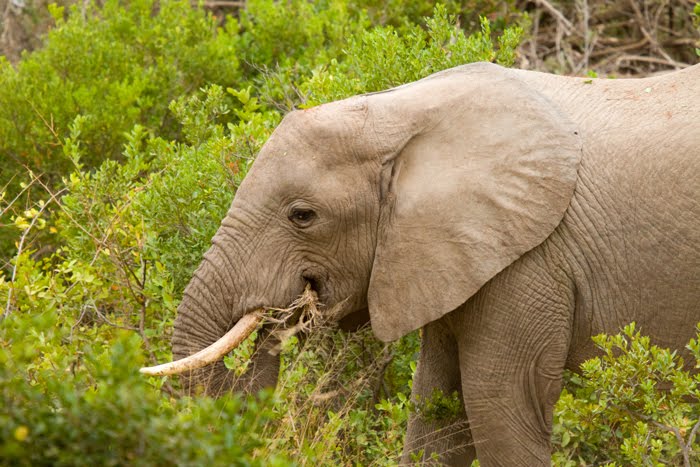
We didn't see any elephants (Tembo) during the first trip through the WMA, but on the second tour through we found a couple foraging in the trees.


We saw a small group of Bat-eared Foxes but they were quite shy and didn't allow for a very close approach.


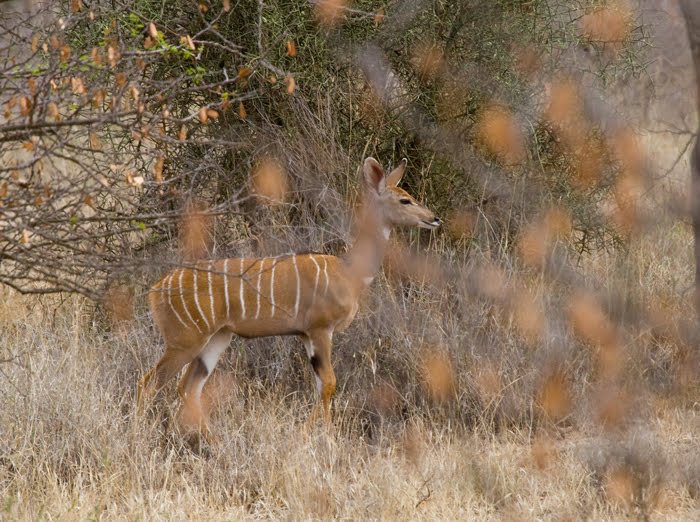
One afternoon I has some free time and went for a short hike around the lodge. I wound up sitting on a small outcrop above the next drainage to the north and watched for a bit. After I had been there for a short while I saw a female Lesser Kudu emerge from the bush and slowly make her way up the drainage towards me. She was soon followed by a few other female and young as well as this bull.


I managed to sneak up pretty close to the group and got this photo of one of the females. When I tried to shift a bit to get a clearer view she spotted me and was gone.


There were lots of Grant's Gazelles, Thompson's Gazelles, and Impala in the WMA. This male Grant's Gazelle sported one of the largest sets of horns that we saw in the WMA.


I couldn't let this post go without at least one bird photo but it is pretty close to a large mammal. We found a few Kori Bustards in the WMA. These are purportedly the heaviest flying bird in the world and although I never saw one fly, the certainly did look quite hefty on the ground.

Friday, December 3, 2010

More Dar es Salaam

This blog has been a bit erratic and downright moribund lately so lets get back to it. I am going to begin by starting back in Dar es Salaam and continuing with posts about the rest of my trip. I will also throw in a post here and there concerning life here and now.
Let's see, I left off with a couple of post about my first day in Dar. Let start this again with my next morning on the coast.

Steve and I had decided that we would go birding for a bit the next morning prior to our meetings. We decided that we would go back towards the scrub habitat behind the hotel.

As we walked along the drive heading back toward the area a gentleman drove by and warned us that the area just to the north was a restricted area and that we should be careful because others had been harassed and had their binoculars and cameras confiscated. We decided that we would head back south of the hotel after that.
Just as we were turning around to head back south we spotted a large bird perched on the top of an agave stalk about 100 meters away (yes agave - one of the exotic plants found in Dar). We were just getting our binoculars on it when it starting flying towards us. As it passed by us just a few meters away it became very apparent that it was a hornbill of some sort. My first hornbill! I flew into the trees [no I didn't fly into the tree! Thanks Mom for the edits] just to the south of us and we were able to locate it again quite close to us after a brief search. We got great looks at this Red-billed Hornbill as he preened in the early morning light. I have been fascinated by the hornbill family for many years and it was really nice to finally see a member of this family in the wild.


We started back towards the hotel and it probably was a good thing we did. While we were watching the hornbill another person had drove up and seemed quite agitated that we were there and got on his cell phone. As we were walking down the street towards the main road he drove by, glowering at us as he went past.
So if you ever wind up staying at the SeaCliff Hotel in Dar and think the habitat just north of the hotel looks like a great place to go birding, it is. Just consider yourself warned!
We continued south from the hotel along the coast through some heavily modified habitat bordering the cliffs along the coast. We found many of the same species we observed before but one nice addition was a Brown-chested Barbet at the top of a tree in the residential neighborhood near the hotel.


The rest of the day was occupied by meetings and work sessions with the other team members, then packing all of our stuff to depart to the various wildlife management areas we were assigned to. Janet (my teaching partner) and I were heading to Enduimet Wildlife Management Area on the north western slopes of Mount Kilimanjaro.

Saturday, August 21, 2010

The Slopes of Kilimanjaro


Amboseli....Serengeti..... Kilimanjaro..... Tsavo.

Places that occupy a back corner of my mind from a lifetime of an interest in wildlife.

"At first it was hardly more than a feeling in the ground, from out in the night somewhere. Then there was a bass cough, and crumping sobs gathered and went rolling about the dark, one by one, like barrels tumbling. It was the lion song, and I sat quiet to learn it, as you learn the trill of a tree toad, or how an alligator goes. And though there may have been little real song in the sound , it came in strong and lonely through the whisper of the mist; and to me, at the same time, it seemed to tell of an age being lost forever."
Archie Carr - Ulendo

Now I am going to see the Serengeti myself.

I will be working in the Enduimet Wildlife Management Area this fall. The Enduimet WMA is in the northwest of Mount Kilimanjaro just across the border from Amboseli National Park in Kenya. I have been reading as much as I can on the conservation issues associated with the wildlife management areas in Tanzania and it is amazing how much the issues, particularly the socio-political aspects of conservation, parallel much of what is currently going on where I live and work. More on that when I get back for sure.


Now I need to get ready.