Monday, March 28, 2011

"Spring"


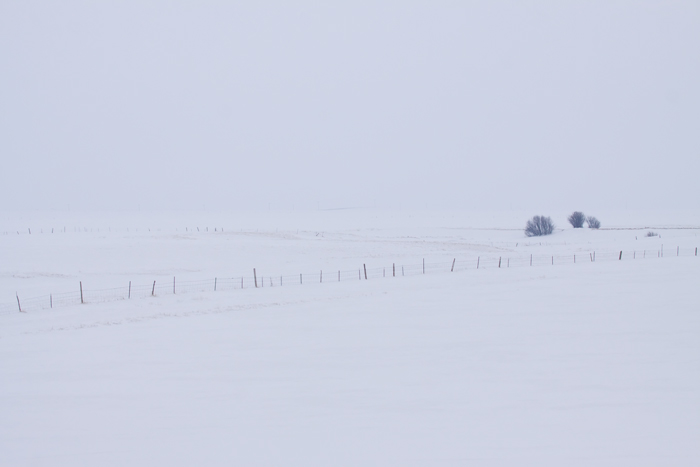
This is what Northeastern Montana looks like right now. 105 inches of snow and counting since the beginning of October. I bet we will have more than 120 by the time the snow ends (if it does). Normally we would be doing sage-grouse lek surveys in a week but I doubt that there will be much surveying done this spring (at least not anytime soon).


Last Friday I came home from further south and found large flocks of Western Meadowlarks and American Tree Sparrows along the highway - apparently stacked up by the the deep snow further north.

Tuesday, March 8, 2011

New Neighbors


These guys are hanging around my new temporary neighborhood.


Tuesday, February 15, 2011

The Story of Pronghorn 166


Last year about this time I witnessed the capture of a Pronghorn doe. She was spending the winter just west of Glasgow with a large group of other Pronghorn. She was singled out and captured by a crew using a helicopter and a net gun and then fitted with a GPS collar as part of a research project by Andrew Jakes. The number written on her ear tag is 166. I have previously posted about her capture and location over the summer.


A few weeks ago I received a phone call from Andrew. He had just completed a flight to see if the animals wearing collars for his study were still alive after this extraordinarily snowy winter that has been so hard on these animals. Surprisingly, most of his animals were still alive, but he informed me that 166's collar was emitting a mortality signal (if the collar does not move a certain period of time, the signal changes so that researchers know the animal is most likely dead).


The news wasn't entirely unexpected with the number of animals dying this winter. However, what he told me next was rather remarkable.
Andrew told me they thought she was next to the highway and that she had probably been struck by a vehicle.


That wasn't the remarkable part; lots of Pronghorn have been struck and killed by vehicles this year.
The remarkable part was where it happened.
The mortality signal from her collar told us she was about 9 miles west of Jordan, Montana near highway 200. This location is approximately 70 miles south of where she was captured last winter and in between was Fort Peck Lake and miles of rugged Missouri River Breaks habitat not generally known as winter habitat for Pronghorn.
I had just driven that highway a day earlier and went right past her. My path and hers had crossed again, although at the time I didn't know it. I had noted a number of dead antelope on that trip and I even thought I might know exactly where she was at.


Ten days ago Kelvin Johnson, FWP biologist from Glasgow, and I headed south to find her. We found plenty of Pronghorn on our drive south, all gathered together trying to make it through the winter.

The animal I remembered in the ditch was a buck and about four miles for the spot we were given. About a half mile from the location, we found the remains of about four road killed Pronghorn and figured she must be in this group. The receiver picked up no signals and none of the heads we could find had an eartag. We continued down the road to our given location and found a lot of Pronghorn wintering just south of the highway. But we didn't find 166. No signal. Nothing.


This is the area we were searching in.


We walked around a bit and went to the top of the ridge near the location, and turned the antenna in all directions, but still no signal. We headed home disappointed to not have found her and speculated a number of different ways to explain why we couldn't find her. My sentimental favorite was that she had just stayed curled up for so long that the mortality signal had kicked on but she was still alive and now was wandering around further south. There were two other live Pronghorn with collars in the area (both had made a similar trip as 166), but we didn't pick up the signal from those animals either. Maybe the receiver wasn't working well. Maybe.....

Another flight early last week put to rest my idea that she was still alive. The location of the mortality signal was a bit elusive, but it was still there. A new location, not that far from the old location, was passed my way.

Last Friday I was once again heading down this highway on my way home. I really wanted to be the one to find 166. She had become a special animal to me so I borrowed an antenna from the FWP biologist in Billings and a receiver from another FWP biologist in Roundup and headed north. I had gotten out of town much later than I had wanted and it was starting to get dark when I got near the new location. I knew that the signal on the collar quit for portions of the day but I didn't know when that was. I told myself that if I put the antenna on the receiver and wasn't able to pick up a signal, I would have to try again another day. It was quite cold and blowing when I stepped out of the car and turned on the receiver. I tuned in the frequency, plugged in the antenna and immediately heard loud beeps coming from here collar. I was very close.


The signal directly led me down the ditch on the north side of the highway about a quarter mile when I noticed a leg sticking out of a snow bank and then the top of a Pronghorn head. I pulled the antenna off the receiver and waved the receiver over the head. No signal. Must not be her but I know she is close. As soon as I put the antenna back on the receiver it became very apparent that the antelope I was looking at had to be her. I brushed the snow back from around her neck and there was the collar. I had found her. It was close too - I later found out the transmitter was scheduled to turn off at 5:00 pm and the time on my photos was 4:46.


Above you can see the back of her head with the yellow ear tag. There was a small chunk of wire stuck in the eartag - a testament to the trials these animals undergo each year during their migrations. The prior week she must have been too well buried in the snow for us to pick up a signal from her collar.


Above is a GoogleEarth map where I plotted the known locations we have of 166 from the VHF transmitter on her collar - where she was captured (in the middle), her summer location (top, just north of Limerick, SK), and her final location (bottom) - a line nearly 170 miles long. It was amazing how near her capture location was to a straight line between her summer spot and the point of her demise. But the more interesting part is going to be when we get the GPS locations from her collar to see what she did in between those points and the path she took to get that far south after the snow started. So - more to come regarding the story of Pronghorn 166 and her extraordinary journey.

Wednesday, February 2, 2011

More Pronghorn


Jack Frost descended on northeastern Montana with a scythe this year and he has been busy using it. I received word today that the Pronghorn deaths from train collisions in the last few weeks is now at least 700 animals across the the northern part of Montana.
As I drove south from Fort Peck to Billings this morning I witnessed first had that it's not only trains that old Mister Frost is using to exact his toll. Exhaustion and starvation are now coming into play full force. As I have mentioned before, the snow is deep and crusted and the last two nights the temperature had dipped well below zero, tapping even more energy from these animals just to stay warm. Forage is hard to come by and with well over a month to go before we usually have any relief with warming temperatures and melting snow, Jack is going to be busy in February.
In addition to the railroads, our highway are also one of the few places left where snow depth does not limit movement and the Pronghorn are using the roadways to move too. With the same results as the railways. I came across a number of spots where a vehicle had plowed into a herd of Pronghorn moving down the highway, resulting in twisted, frozen carcasses tossed in the ditches on either side of the road.
It has already been a long winter for these animals and it is probably going to get worse before it gets better. March and melting snow can't come soon enough.


Monday, January 31, 2011

Pronghorn update


Just couldn't do another Pronghorn in the snow photo so I am using this one to think of better days. I found out this morning that at least another 70 animals were struck by a train in one event this weekend, plus another 30 or so in a different incident. This pushes the known direct mortality from train strikes to nearly 400 Pronghorn in the last few weeks. Certainly there are additional indirect mortalities associated with these events along with mortalities associated with starvation, predation, and vehicle strikes that push the loss of animals even higher.
This is a killer winter where the impacts of landscape changes are most evident and detrimental for most of the big game animals in this area. Continuing changes to the landscape inhibit the movement of animals and leaves them stuck in areas where they are unable to survive. These changes are not as evident during most winters, but when the chips are down and the animals need to be able to move easily to survive, the impacts are amplified. The effects of these incidents and landscape changes on these populations is going to be felt for a long time.

Sunday, January 30, 2011

Return to Tanzania


Since it looks like we broke the record for the most snow for the season last night (still snowing now) and the temperature is heading well below the zero mark for the next few days, I think that it is about time to return to Tanzania. But it looks the only way I am going to be able to do that is post about it here.


To recap, I was in Tanzania to train Village Game Scouts (VGS) how to conduct more rigorous natural resource monitoring as part of their regular duties conducting anti-poaching patrols at the Enduimet Wildlife Management Area (WMA).


Enduimet WMA is located west of Mount Kilimanjaro along the border with Kenya.


I was part of a team working for the Department of Interior's Technical Assistance Program. There were ten of us on the team, divided into five teams of two, each team assisting with a different WMA. My partner at Enduimet was Janet, a botanist from the US Fish and Wildlife Service in Alaska.


This is Eric, our driver.


We worked very closely with the Longido District Game Officer (DGO) Stephen (on the right), his local commander Charles (on the left), and Julius (middle), a representative for the African Wildlife Foundation, a non-governmental agency partner in the management of the WMA.


When we arrived at Enduimet, we toured the VGS outposts in the WMA. These guys are amazing. They accomplish a lot with little resources. The shed in the back is where they cook and store their equipment. They sleep in small individual tents scattered around the outpost. The conduct anti-poaching patrols on foot from their outposts and spend four weeks at a stretch on duty.


Our training was conducted at the WMA headquarters in the village of Ol Malog. Each morning the scouts would go through their drills prior to the training.


We spent most of our time outside doing more practical instruction. Here Janet is teaching the scouts how to set up and run a habitat transect to measure vegetation.


We did spend some time inside the WMA headquartes in the village of Ol Malog. Here the scouts are going through the field guides we provided them, The Birds of East Africa and the Kingdon Pocket Guide to African Mammals. I would recommend both guides for any trip to East Africa.


We also taught the scouts how to measure grass biomass using the pasture disk method.


Since there wasn't much wildlife near the village, we improvised and used the numerous cattle, sheep or goats as surrogates when we taught the scouts how to conduct wildlife transect surveys.


At the end of the training we had the scouts run their own transect as a practical test. The transect was run from one of the outposts and this time we had real African wildlife to use on the transect.


At the end of our training we had a ceremony with a number of dignitaries where the scouts received their certificates of completion. Here Obedi is reciting a speech where he expressed the scouts appreciation for being selected to receive the training as well as appreciation for the content of the training.


The primary management challenge at Enduimet is the heart of this type of conservation effort - how to integrate local people and villages into conservation efforts so that the people realize some gain from having wildlife on the landscape. It is a difficult challenge but necessary as more and more people inhabit areas that have traditionally not been heavily impacted by human land use and still have wildlife habitat and populations. More people exert pressure on local wildlife through direct conflict (where the wildlife usually loses) to more subtle, indirect impacts through habitat changes or loss. One example of indirect impacts to wildlife at Enduimet is the increase use of water for agriculture at the upper ends of the watercourses near the mountains. This limits the amount of water that makes it to the area where wildlife have traditionally been able to access the water and puts additional pressure on the remaining sources of water needed by both wildlife and domestic livestock. Competition for scarce water tends to increase the incidents of direct conflict with wildlife.


Grazing by domestic livestock is the primary land use in the WMA.


The transition from unlimited land use to a conservation focus that will realize income from wildlife and wild lands in addition to livestock grazing is an experiment that is progressing, but the hoped for results are still years away if the experiment succeeds. Traditions change slowly.


Another management challenge is unsustainable cutting of firewood in the WMA.


On the other end of the management challenge is improving the infrastructure so that income from tourism related to wildlife can be realized for the villages. Right now the roads in the WMA are not in the best shape. That, combined with the distance from the traditional wildlife tour circuit, currently limits the amount of tourism this area receives.