Friday, December 3, 2010

More Dar es Salaam

This blog has been a bit erratic and downright moribund lately so lets get back to it. I am going to begin by starting back in Dar es Salaam and continuing with posts about the rest of my trip. I will also throw in a post here and there concerning life here and now.
Let's see, I left off with a couple of post about my first day in Dar. Let start this again with my next morning on the coast.

Steve and I had decided that we would go birding for a bit the next morning prior to our meetings. We decided that we would go back towards the scrub habitat behind the hotel.

As we walked along the drive heading back toward the area a gentleman drove by and warned us that the area just to the north was a restricted area and that we should be careful because others had been harassed and had their binoculars and cameras confiscated. We decided that we would head back south of the hotel after that.
Just as we were turning around to head back south we spotted a large bird perched on the top of an agave stalk about 100 meters away (yes agave - one of the exotic plants found in Dar). We were just getting our binoculars on it when it starting flying towards us. As it passed by us just a few meters away it became very apparent that it was a hornbill of some sort. My first hornbill! I flew into the trees [no I didn't fly into the tree! Thanks Mom for the edits] just to the south of us and we were able to locate it again quite close to us after a brief search. We got great looks at this Red-billed Hornbill as he preened in the early morning light. I have been fascinated by the hornbill family for many years and it was really nice to finally see a member of this family in the wild.


We started back towards the hotel and it probably was a good thing we did. While we were watching the hornbill another person had drove up and seemed quite agitated that we were there and got on his cell phone. As we were walking down the street towards the main road he drove by, glowering at us as he went past.
So if you ever wind up staying at the SeaCliff Hotel in Dar and think the habitat just north of the hotel looks like a great place to go birding, it is. Just consider yourself warned!
We continued south from the hotel along the coast through some heavily modified habitat bordering the cliffs along the coast. We found many of the same species we observed before but one nice addition was a Brown-chested Barbet at the top of a tree in the residential neighborhood near the hotel.


The rest of the day was occupied by meetings and work sessions with the other team members, then packing all of our stuff to depart to the various wildlife management areas we were assigned to. Janet (my teaching partner) and I were heading to Enduimet Wildlife Management Area on the north western slopes of Mount Kilimanjaro.

Thursday, December 2, 2010

Long live the laptop

Help has arrived and the new laptop is now working. New post tomorrow!

Monday, November 15, 2010

Laptop Dead

My old laptop finally died. The operating system apparently has a fatal error so posting may be slow (again) for a bit.

Thursday, November 11, 2010

Here and Now Interlude

I will return to the recollections of Tanzania soon, but I felt I needed a quick post about Montana. Yesterday I got to tour a mine reclamation site for work. It was cold and snowy. And full of Bighorn Sheep.


The snow on the opposite slope created an interesting pattern on the new vegetation growing in what appeared to be an old burn area.

Sunday, November 7, 2010

More Dar in in the Afternoon

In the afternoon I managed to head north from the hotel after looping through a small road just to the west. There was a notice at the end of the road warning me not to go any farther and to not take any photos. So I headed east to the coast and then wandered into what appeared to be native coastal scrub to the north. No sign so I figured I was ok. I didn't see too much for new birds that afternoon but there were a few I could see and many more I could only hear or catch a quick glimpse of.
It was nice to be away from all the people and into some decent looking native vegetation for a bit to struggle with the identification of birds I had only rehearsed identifying from the field guide. I wound up using the camera as an identification aid much more than I anticipated. It was nice to have even rather crappy photos to use as an ID aid latter when I had time to use the field guide when there weren't new birds all around me.
There were a few Zanzibar Sombre Greenbuls around.


And a couple small groups of Speckled Mousebirds.


But the best bird by far was a member of the sunbird family, the Nectariniidae. This was one group of birds I was really looking forward to seeing and my first introduction was a stunning Purple-banded Sunbird foraging in a bare tree just around the corner from the hotel.


Later that afternoon, Steve Windels, a biologist from Minnesota and a member of our technical assistance team, and I headed south from the hotel along the coast into some severely modified habitats. We found quite a few birds in the open fields and remaining scrub. There was the seemingly mandatory House Sparrows, but also a number of wonderful new birds too. They included Blue-capped Cordon-bleu


African Red-billed Firefinches


A Grassland Pipit


and Black and White Manakins.


Later that afternoon we went to the Mwenge carvers market to look for goodies for family back home. I was introduced to a wonderful little shop with a great selection of masks and other assorted carvings.


Later that evening we had a few moments to sample some local brews and do a bit of birding looking over the tidal flats again.


And as the sun dropped quickly into the hazy horizon to the west (no sliding slowly at an angle into darkness here at the equator) the Palm Swifts emerged into the twilight.


The next day was a series of meetings and prep work but there were more birds to be found and even better, I had Steve, the mammal guy from Minnesota, hooked on looking for birds with me.

House Crow City - Dar es Salaam

My first introduction to Tanzania was via the large, sprawling city of Dar es Salaam. We arrived at the international airport late at night and headed to our hotel along the coast near the tip of the Msasani Peninsula. The next morning I woke up and opened up the window on my room to see what I could see.


I was looking east over the Indian Ocean and down on to a rather lush hotel garden area. My expectations were high and so was the humidity. Maybe something other than a Rock Pigeon, House Sparrow, or European Starling would be the first bird I found on this new continent? Turns out it was something different - but not really. The first bird I found was a House Crow. A species introduced into Dar from southeast Asia which has multiplied prodigiously in the area to the detriment of any of the native species they encounter. Sound familiar?


There were many House Crows. Lots and lots of House Crows. And nothing else. I made my way down to the hotel grounds and looked out over the exposed tidal flats and slowly started to find new birds.


Well, kind of new birds. First there was a Whimbrel slowly foraging in the tidal pools. Hadn't seen one of those for a while but still not new. There was also a Grey Plover strolling along the pool edges. A new name for a bird I have observed quite a few time in Montana. We just call them Black-bellied Plovers.


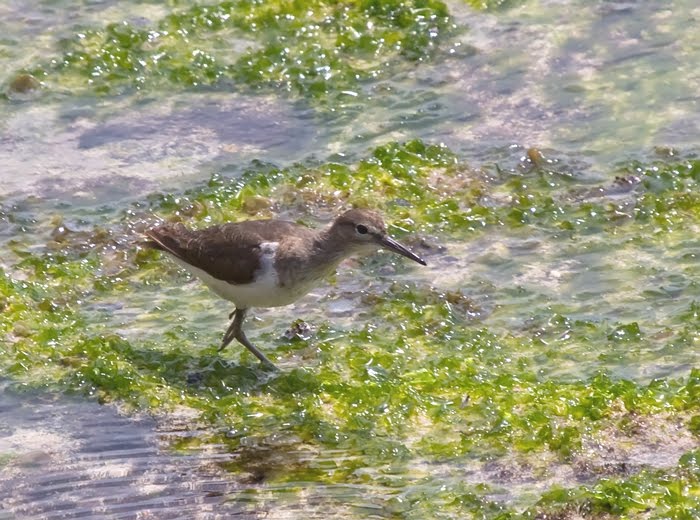
Then there was a Common Sandpiper. New bird for sure, but it certainly looked almost exactly like the Spotted Sandpipers from home.


Then the really new birds started showing up.


A Little Egret


a Dimorphic Egret


And an immature Striated Heron.

I was surprised by the lack of the gulls on the coast. Every other coastal habitat I have visited has had a large number, if not large variety, of gulls. Not Dar es Salaam though. I only saw two individual gulls during my time in Dar and both appeared to be Lesser Black-backed Gulls.


There were also a number of young men that roamed the tidal flats with large jugs and small hand nets. I was never able to determine exactly what fish they were catching but I assume that they were for the tropical fish trade.

Any comments on my identification of the birds of Tanzania are welcome.

Monday, October 11, 2010

Rare Birds

It is always a treat to find a rare bird. When I was in Tanzania nearly every bird species I observed was a rare (in most cases brand new) species for me. It appears that one species I observed is also a rather rare species for Tanzania.
On September 25, 2010 I traveled from where I was working (I will talk more about that later) to visit my friend Steve Windels who was working at a Wildlife Management Area near Lake Manyara in north central Tanzania. That afternoon we went for a walk to look for birds along the lake shore. As we were walking we talked about the birds that Steve had observed at the lake. He mentioned that he had observed Slender-billed Gulls, but added that according to the range map in the bird book, Birds of East Africa, they shouldn't be here. I passed it off as a situation where the distribution of this species was poorly known and it probably had been recorded at the lake before but the maps in the field guide were out of date. Shortly after our conversation a pair of gulls flew by that appeared to be Slender-billed Gulls. I snapped off a few photos as they flew by.


Upon returning home, I figured I would do some research to find out about the current status of the Slender-billed Gull in Tanzania. I checked the Tanzania Bird Atlas Project website and blog and found out that the first recorded observation of a Slender-billed Gull had occurred in March of 2006 at Lake Victoria. There has apparently been only one observation of this species since then so our observation would represent the apparent third record for Tanzania.


The Black-headed Gull, which is more common here, would not have such an elongated face and long bill, there is usually a black earspot on Black-headed Gulls in winter plumage (breeding birds would have a black head), and would have a dark eye (although faint, it appears that these birds do have light colored eyes).
I wish I had been more cognizant of the status of this species in Tanzania before we saw the birds. I was overwhelmed at that point with the number of birds we were seeing that afternoon and I have no notes about this observation. I know there were at least two individuals from the photos I took, but there may have been at least one more individual that flew by.
This was certainly not an species I would have considered the most exciting of the birds I found during my stay in Tanzania, but now, after having found out how rare it is to see there, it is a rather exciting observation indeed.