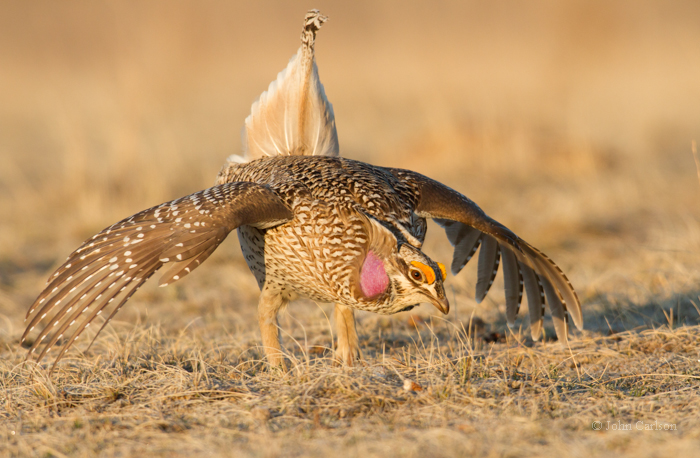
Early last week I took a few days off and headed north to spend a couple of mornings on a Sharp-tailed Grouse and Greater Sage-Grouse lek after the weather looked like it was going to cooperate and there would be a few days without snow, wind, and clouds.
My first morning was great. I set my blind up on my favorite sharp-tail lek the night before and shortly after climbing into the blind I had a number of males displaying around me. The rapid-fire thumping foot stomps of the displaying birds sounded like distant machine gun fire. The percussions were combined with cooing and chuckling as the birds jostled with each other in the dark. As dawn flowed towards me I could slowly discern the shapes of the birds and the sounds from the darkness merged with their dancing bodies.
 |
| Sunrise reflected in the eye. |
From this point until the sun actually appeared above the horizon is the most difficult for the photographer, but often the most enjoyable for the biologist. There is usually a lot of action on the leks between dawn and sunrise as the females arrive and the males kick displaying into high gear, but not enough light to make good photos. This morning was no different, but thankfully the female sharptails keep arriving after the sun appeared behind me so the photographer was as happy as the biologist.


I find displaying sharptails to be more entertaining than sage-grouse with their more vigorous displays and frequent jumping fights providing lots of action. One fight this morning was memorable as both birds kept at it for at least 5 minutes. They were on the edge of my field of view from the blind opening and the fight was mostly auditory for me, but the intensity was still evident in the sharp thwacks of wing strikes and bird growls that occurred around me. At one point they fought all the way around my blind.
That evening I headed west and set up on one of my favorite Greater Sage-Grouse leks that in the past has had about 20 males on it. This is gumbo clay country and the spring snows had saturated the landscape. There wasn't much of a footprint of bird activity on the lek, but I thought that it probably was because the frozen ground and recent snows had erased signs of more action.
The next morning I trekked to the lek shortly after the nearly full pumpkin moon slipped below the western horizon, but before dawn had reached the eastern sky. I could hear a couple of birds displaying nearby shortly after I arrived and soon I could hear the more wingbeats settling into the sage around me. However, when it became light enough to see the birds on the lek I realized the the amount of bird sign I had noticed the night before really was indicative of the number of birds on the lek. There were only 7 males displaying in front of me. Even though there were just a few birds, they were right where I wanted them and the light was looking promising for the photographer. As the photographer waited, the biologist enjoyed watching as two females wandered towards the dominant male and then fought with each other for position in front of him. I also noticed that the male displaying just to my right has lost most of his tail feathers and his displays had a very unbalanced appearance. In short order the winning female was bred and then the other female as well. They then wandered off into the sagebrush away from the lek... and six of the males walked their dancing after them and disappeared over the edge of the rise the lek was located on just as the sun was breaching the sky and the light was getting good. Of course the one remaining male was the half plumaged bird. I managed to get a few photos of him in the early light, but just as the sun rose and lit him well, something spooked another bird behind him and out of my sight and the entire group flushed and flew away over a distant ridge and like that the biologist and the photographer were done for the day with the biologist certainly getting the most out of the morning.

The forecast for that night and the next morning, the last of my trip, was high winds, snow, and overcast so I decided not to try my luck at the sharptail lek again. I could have dealt with the wind and snow, but when it was supposed to be combined with overcast skies, it just didn't seem like it would be worth it. Wrong. The next morning was a bit breezy and it had snowed, but it was clear and the sunrise on the new dusting of snow was wonderful. Dang.